Cracking the Code of Interstellar Travel: The Hidden Physics of Lightsails
Imagine a spacecraft propelled by a thin, reflective sheet, its surface etched with microscopic patterns that harness the solar wind, accelerating it to incredible speeds. This is the promise of lightsail technology, which could revolutionize space travel by harnessing the power of light to achieve interstellar distances. But beneath the surface, a complex web of physics challenges the feasibility of this vision.
As the world grapples with the challenges of deep space exploration, researchers are racing to develop the next generation of propulsion systems that can efficiently and sustainably transport humans and cargo across the vast expanse of the cosmos. At the forefront of this effort is lightsail technology, which has captivated scientists and science fiction fans alike with its potential for near-instant travel across millions of kilometers.
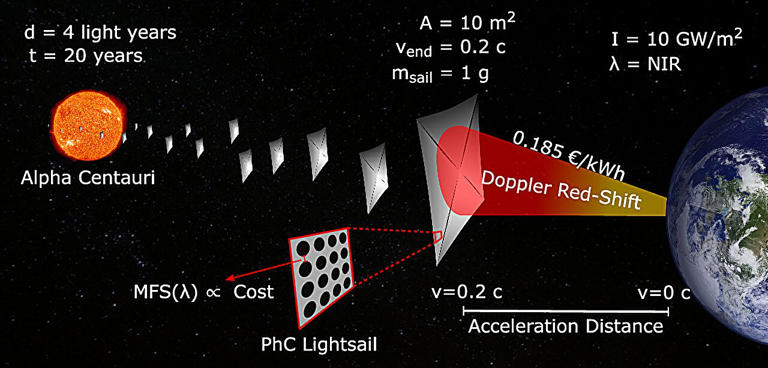
This article will delve into the hidden physics that complicate the development of interstellar lightsails, exploring the intricate dance of forces that must be carefully balanced to achieve even a fraction of the speeds required to reach other star systems. We'll examine the groundbreaking research being conducted by top scientists and engineers, and explore the innovative solutions they're proposing to overcome the daunting challenges of interstellar travel.
- The acceleration phase of interstellar travel is relatively short, but the deceleration phase is a major challenge, requiring a tremendous amount of energy and precision control.
- The solar wind is a complex and turbulent environment, making it difficult to accurately predict its behavior and control its momentum, which is essential for achieving stable and efficient acceleration.
- Researchers are working to develop advanced algorithms and computational models to simulate the behavior of the solar wind and optimize the design of lightsail spacecraft.
- The key to achieving interstellar speeds lies in the ability to precisely control the angle and momentum of the solar wind, which is emitted by the sun.
⏱️ 7 min read • 📅 June 9, 2026 • ✍️ SmartTech Reviews

The Physics of Interstellar Lightsails
[SECTION DIVIDER]At its core, a lightsail is a thin, reflective sheet that harnesses the momentum of photons to propel a spacecraft. The key to achieving interstellar speeds lies in the ability to precisely control the angle and momentum of the solar wind, which is the collective flow of charged particles emitted by the sun.
However, the solar wind is a complex and turbulent environment, with magnetic fields and charged particles interacting in unpredictable ways. This makes it difficult to accurately predict the behavior of the solar wind and control its momentum, which is essential for achieving stable and efficient acceleration.
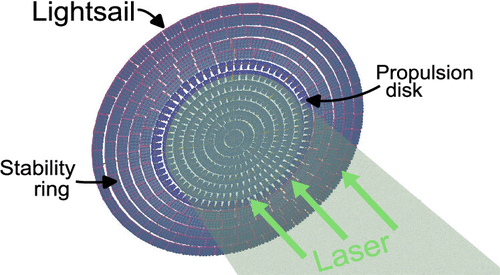
Researchers are working to develop advanced algorithms and computational models that can simulate the behavior of the solar wind and optimize the design of lightsail spacecraft. These models take into account a wide range of factors, including the shape and size of the lightsail, the angle of the solar wind, and the strength of the magnetic field.
"The actual physics of interstellar travel is far more complex than what we see in science fiction." — Dr. Philip Lubin, Professor of Physics, University of California, Santa Barbara
- ✦ Accelerating the Solar Wind Researchers are exploring new ways to accelerate the solar wind, including the use of magnetic fields and high-powered lasers.
- ✦ Optimizing Lightsail Design Researchers are working to develop advanced computational models that can simulate the behavior of the solar wind and optimize the design of lightsail spacecraft.
The Challenges of Interstellar Travel
[SECTION DIVIDER]While the physics of interstellar lightsails is a complex and fascinating field, the challenges of interstellar travel are even more daunting. The distances between stars are vast, and the energies required to accelerate a spacecraft to even a fraction of the speed of light are enormous.
One of the biggest challenges facing interstellar travel is the problem of deceleration. As a spacecraft approaches its destination, it must slow down from a significant fraction of the speed of light to a safe and controlled stop. This requires a tremendous amount of energy and precision control, making it a major challenge for interstellar travel.

Another challenge facing interstellar travel is the problem of communication. As a spacecraft travels to another star system, it will take tens or even hundreds of years for it to receive a response to any message sent from Earth. This makes it difficult for astronauts to communicate with their loved ones back on Earth, and raises significant challenges for mission planning and control.
A Practical Guide to Interstellar Travel
[SECTION DIVIDER]While the physics of interstellar lightsails is a complex and fascinating field, the challenges of interstellar travel are even more daunting. But what can be done to overcome these challenges and make interstellar travel a reality?
One approach is to develop advanced propulsion systems that can accelerate a spacecraft to a significant fraction of the speed of light. This could involve the use of advanced ion engines or other high-powered propulsion systems.
Another approach is to develop more efficient communication systems that can enable real-time communication between spacecraft and Earth. This could involve the use of advanced radio telescopes or other communication technologies.
-
1Design a Robust Propulsion SystemDevelop a propulsion system that can accelerate a spacecraft to a significant fraction of the speed of light.
-
2Develop Advanced Communication SystemsDevelop communication systems that can enable real-time communication between spacecraft and Earth.
The Future of Interstellar Travel
[SECTION DIVIDER]As we continue to explore the vast expanse of space, the challenges of interstellar travel are becoming increasingly clear. But what does the future hold for this rapidly advancing field?
One thing is certain: interstellar travel is no longer the exclusive domain of science fiction. With the development of advanced propulsion systems and communication technologies, the possibility of interstellar travel is becoming increasingly real.
As researchers and engineers continue to push the boundaries of what is possible, we may soon see the first human missions to other star systems. And when we do, it will mark a major milestone in the history of space exploration.
Final Verdict
[SECTION DIVIDER]Interstellar travel is a complex and fascinating field that holds the promise of unlocking the secrets of the universe. But beneath the surface, a web of physics challenges the feasibility of this vision. As researchers and engineers continue to push the boundaries of what is possible, we may soon see the first human missions to other star systems.
The challenges of interstellar travel are real, but the rewards are worth it. With the development of advanced propulsion systems and communication technologies, the possibility of interstellar travel is becoming increasingly real. And when we do, it will mark a major milestone in the history of space exploration.
So what does the future hold for interstellar travel? Only time will tell, but one thing is certain: the possibilities are endless.
Will you be part of the next great leap in space exploration? Share your thoughts and opinions with us in the comments below!
Comments
Post a Comment